

In June 2023, Representative Ed Osienski of Newark introduced the “Everybody Gets Home Act,” the first ever attempt to pass an anti-stroad law. Business interests objected to several provisions of the bill which led to changes, but the modified law eventually won unanimous support in both the House and Senate. In one of his final official acts, Governor John Carney signed the legislation into law on November 1.
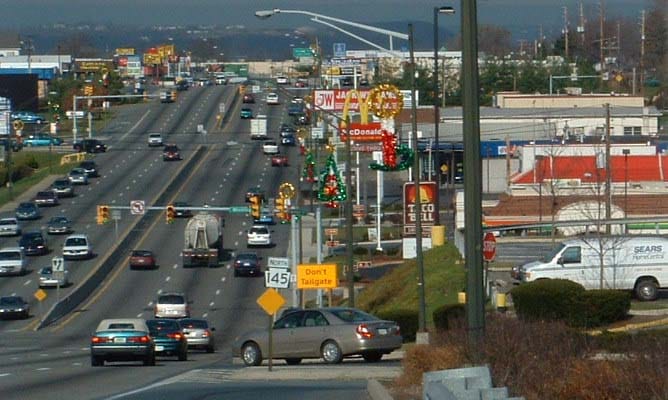
“If you live in Delaware and you went shopping this week, or had a dentist appointment, or dropped off your kids at school, or drove just about anywhere, there is a fairly high likelihood you had the regrettable experience of driving on a stroad,” Bike Delaware stated on their website. “These are high speed, usually suburban, highways with lots of driveways. Stroads evolved out of decades of piecemeal decisions by county and state officials responding to commercial development. Over those decades we’ve gotten used to them and we now mostly take them for granted, but they are not convenient, pleasant, safe. In fact, mile for mile, they are easily the deadliest parts of Delaware’s transportation system and where most of Delaware’s pedestrian fatalities happen.”
The ”Everyone Gets Home Act” clarifies DelDOT’s authority to acquire property right in order to create new interconnections between commercial properties on stroads so that driveways can be consolidated and closed. It also protects property owners should creating those interconnections cause any kind of problem for the property owner with a county government.
“The stroad provisions in the bill are also accompanied by additional language for addressing Delaware’s extremely serious problem of single vehicle roadway departure crashes which occur on mostly rural roads,” the website stated. “The act lays out clear authority for DelDOT to use a huge array of “safe system” countermeasures, including roadway reconfigurations, narrowing travel lanes, edge line striping, raised medians, pinch points, chicanes, speed humps, speed tables, roundabouts and other options to calm traffic on rural roads to 35 mph or less and reduce fatal roadway departure crashes.”
Bike Delaware believes that if this legislation is aggressively implemented, it will reduce accidents to their goal of less than 60 by 2035.