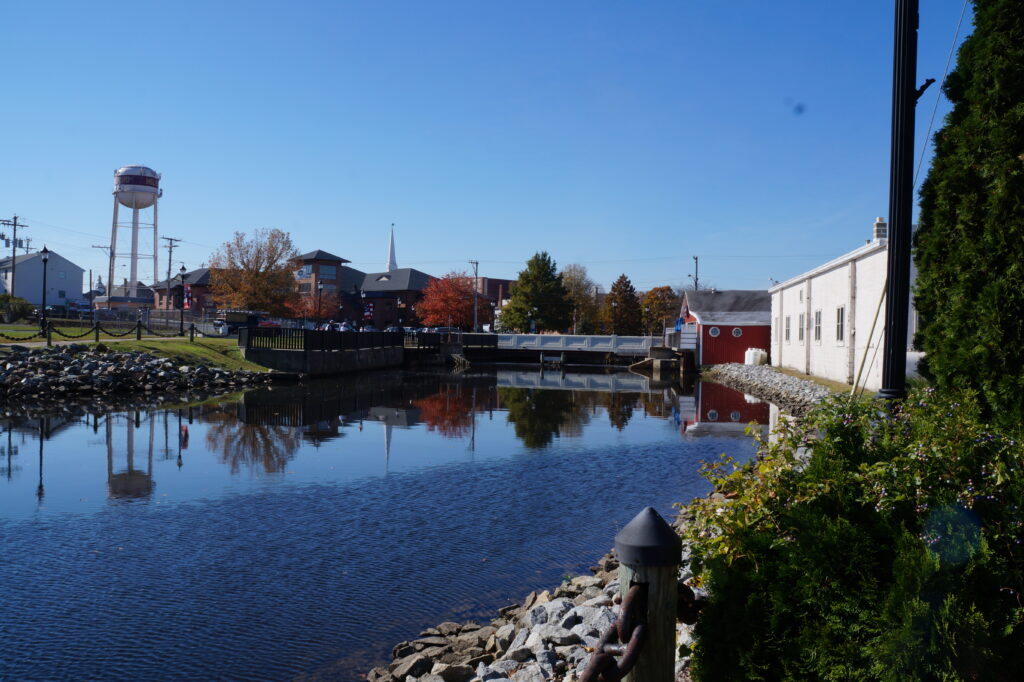


At a recent workshop, City Planner Rob Pierce provided Milford City Council with details on growth and development trends in the city. Pierce explained that the presentation was designed to help the public and new council members understand how growth in the city was managed as well as how development would be managed in the future.
“A lot of the decisions that are made by the city relate back to our Comprehensive Planning document. The last time that we did a Comprehensive Plan was in 2018 and we’re actually gearing up to start the update process in the spring,” Pierce said. “So, there will be some discussions on the coming meetings to potentially partner with the University of Delaware again to go through that plan.”
Pierce stated that the Comprehensive Plan guides overall community goals and that could relate to transportation, economic development, land use, open space and housing. Pierce pointed out that there had been some additional master planning efforts, particularly in the area of the Bayhealth Sussex Campus in Southeast Milford. All of the master plans used by the city are available on their website.
“I did want to take a moment to kind of go back in history a little bit. There was an annexation history map that was provided in our 2006 amendment, so almost 20 years ago now, which kind of shows you what Milford’s municipal boundary looked like many years ago, and it’s not much different than you see today,” Pierce said. “And this is just for reference, we have an annexation plan which showed where our targeted areas to grow were in the early 2000s. If you fast forward to when we did our 2008 Comprehensive Plan update, you can see this is very close. This municipal limit you have here is very close to what you see today.”
Pierce continued, explaining that when the 2008 Comprehensive Plan was completed, the annexation areas were kind of haphazard, so the decision was made to focus on urban growth boundaries which radiated more from the downtown central business district, giving an idea where the city would be over the next 20 or 30 years.
“Fast forward to 2018 when we when we last did our Comprehensive Plan update that urban growth boundary, our targeted annexation area, did not change at all,” Pierce said. “So, we’ve kind of had the same goal of how we thought we were going to grow and what our expenses were over the last 20 years.”
Some of the information provided by Pierce included details on existing land use now compared to 2018.
“About 45% of our land area at the time was either vacant or agricultural land use, and this was land that was within municipal limits, so it was essentially within town and undeveloped as of maybe a month or two ago, there’s about 30% of the total acreage within Milford limits was either vacant or agriculture,” Pierce said. “So, over the last 10 years, we’ve developed 15% of that land that we had in inventory.”
As far as housing, Pierce explained that there had been about 3,400 units constructed with just under 500 going through the development review process, adding almost 4,000.
“That does not include about 650 acres that are vacant and zoned residential within city limits that could potentially yield, based on allowable densities, another 3,200 units,” Pierce said. “So, you have 3900 units approved, a potential for another 3,200, maybe 3,300 units without annexing another piece of property in the city of Milford.”
Pierce explained that at the time of the 2018 update, there were 5,700 approved and proposed units.
“So, about 36 percent of the active projects are single family, detached, 4 percent are duplexes, 21 percent are townhouses, 23 percent are apartments and 17 percent are condominiums. So, there is a pretty balanced inventory of housing types,” Pierce said. “In some areas, there are missing middle types of housing which are the duplexes, townhouses and apartments. We do have a pretty good inventory and diversity of housing types which is one of the goals and objectives from the Comprehensive Plan.”
Pierce explained that in 2014 as the construction industry came out of the 2008 downturn, the city approved 33 new units, all new dwellings. In 2020, the city approved 371 with 227 new dwellings and 144 apartments. As of 2025, the city had approved 131 units with 115 new dwellings and 16 apartments.
“I know many people see a lot of construction going on in the community,” Pierce said. “But a lot of these developments were approved 20 years ago, prior to the downturn in 2007 and 2008, so they were put on hold for a while until the economy rebounded. Watergate was in 2007, Cypress Hall in 2009, Simpson’s Crossing in 2007, Milford Ponds in 2006, Mispillion Landing in 2008. Windward Grove was in 2013 and then another gap until Hickory Glen in 2020, Knight’s Crossing in 2024, Red Cedar Farms in 2024, Riverwalk Villas in 2025.”
Over the last ten years, according to Pierce, the city has only annexed 66 acres of land and approximately 50 of that belonged to Baltimore Air Coil who had an agreement that when their land became contiguous, they would annex into the city. Another six was for the electric substation adjacent to the Sussex Health Campus. That left ten acres in ten years annexed into the city.
“I looked at the Milford Corporate Center and that land was annexed into the city in the late 1980s,” Pierce said. “It took 40 years for something to be bult on it. We are a little under 10 acres, 10-square miles in area at this time. I do want to point out that decisions made by council and the Planning Commission today may not have an impact on the community for 20 years because we are seeing decisions made 20 years ago just start to see some development.”
Councilman Jason James thanked Pierce and his staff for their vigilance in making sure council had full facts before they made any decisions.
“You know, we talk about how the Comprehensive Plan dictates where things should go, that’s our reference point,” Mayor Todd Culotta said. “That can always evolve, it’s a living document. But I think it is imperative for us to know that document. It is 282 pages, so if you read five or six pages a day just to learn it, then when we come here to talk about where Milford should go, what we should be, what we should do, we have the playbook right in front of us.”
James pointed out that when developers come before council, they have already referenced the Comprehensive Plan.
“They know what is allowed and they know the variances they may need to ask for, whether it is approved or not, but they know what the plan says,” James said. “For the most part, developers do their homework before they come to us, and we cannot just arbitrarily abandon this plan as it also partners with our code. Whether it be densities, whether it is R1, R2, R3 or whatever have you. We need to know that as council persons because we need to make informed decisions.”