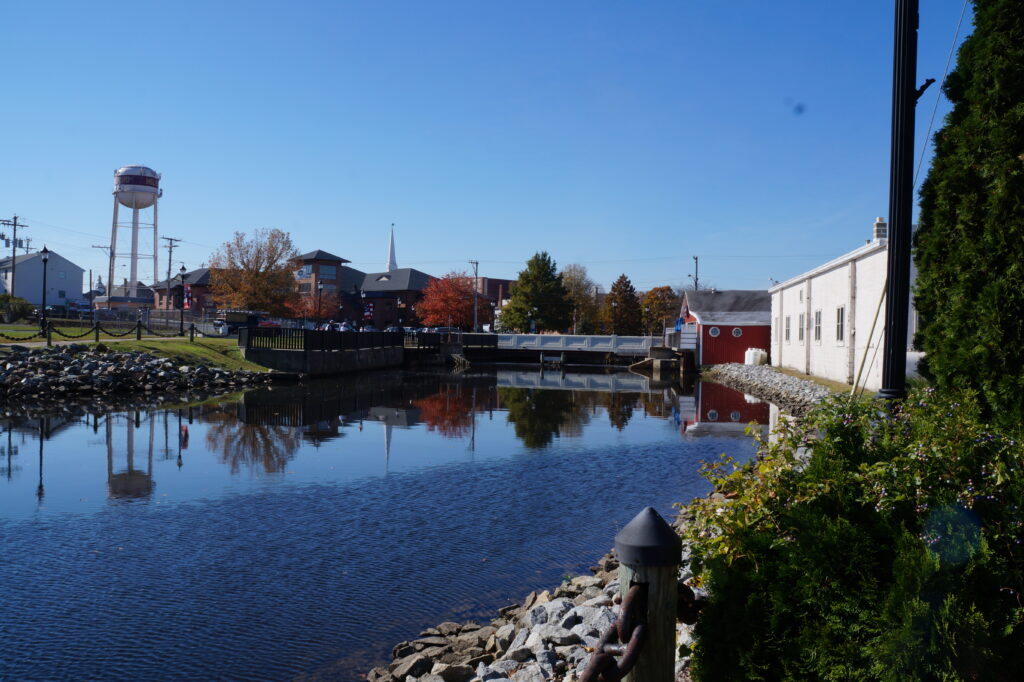
A downtown restroom for the public was approved n Monday, March 2, by Milford City Council as well as a transfer from General Reserves of up to $53,000 for the downtown restroom. The 3-unit heated downtown restroom has a price tag of $435,000, but the city has secured grant funding for all but a portion of the costs.
During the public comment portion of the meeting, two people spoke out against the project.
“I would just like some clear explanation regarding the operating plan for the public restroom,” Julie Morris, who this time gave an address on Cedar Beach Road, said. “Who’s going to clean it? How often? What are the annual operating costs for the utilities, repairs, upkeep? I’d like to hear any security plan, lighting, cameras, locking, how quickly the city is going to respond if it’s damaged or out of service. I’m very curious about this floodplain risk as it is in zone AE.”
Morris wanted to know the distance and base flood elevation of the structure along with any required flood plain permitting documentations and any elevation certificate requirements.
“If it is just going to flood, why are we putting it there?” Morris asked. “I think in talking to a lot of people in the community, most people don’t understand why we are putting a bathroom here. The expense doesn’t seem to make a lot of sense for it, but those grants could be allocated somewhere else.”
Dawn Tomczak, who is running for a Ward 4 seat, also questioned the need for the downtown restroom.
“I don’t understand why we would spend money on those,” Tomczak said. “Like there has to be another alternative. Like, maybe something worked out with the library or one of the restaurants or something like that to try and cut back and save some money.”
Parks and Recreation Director Brad Dennehy provided some background on the project.
“I just want to go back and recap that the mayor and council has previously approved the construction of a prefabricated public restroom in the downtown area, located on South Washington Street in Memorial Park outside the pickleball courts,” Dennehy said. “This area was identified as being both beneficial for users of the basketball courts, pickleball courts, access to the Farmer’s Market and it was contiguous to the Riverwalk for people using it walking through our parks.”
Dennehy continued that council approved $350,000 out of the general fund for the project, but that in July 2025, the City of Milford signed a contract with the Department of Transportation for a grant from the Federal Highway Administration to expand and broaden the use of the Delaware Bayshore Byway. The byway is a national scenic route up and down the East Coast.
“That location went through several vetting’s through the state and the Bayshore administration as a good place for people to stop if they are coming through town, particularly if they are on a bicycle,” Dennehy said. “The grant covers construction of the downtown restroom, wayfinding signage, a bike rack and a bike fix-it station. It is an 80/20 matching grant, so 80 percent federal and 20 percent city.”
In December, the City of Milford was awarded a $50,000 T-Mobile grant specifically for the downtown restroom project and those funds cannot be used for any other project. Working with Becker Morgan Group, the city is in the process of purchasing a prefabricated restroom using a federal procurement bid process which will reduce the time it will take to get the downtown restroom installed. The cost of the restroom itself was between $250,000 and $270,000, but there will be additional site work costs as well.
“We’re looking at about $125,000 as it still has to be permitted, it still has to go through Rob’s office, there will be impact fees, water meter, sewer meter, electric,” Dennehy said. “Our total price would be somewhere in the area of $415,000 to $435,000. We currently have a $332,000 federal grant and a $50,000 T-Mobile grant. That leaves between $32,800 to $53,000 which will be determined once we actually bid out the site work.”
Dennehy was before council to determine if they wanted to go with a four-unit non-heated option. That option would require the bathroom to be shut down during winter months to avoid the pipes freezing. A similar unit was located at the Can-Do Playground and the department dealt with frozen pipes initially before they decided to winterize and close it in the winter.
“The second option is a three-unit heated version,” Dennehy said. “In order to put heating units in, we would lose one of the stalls and we would have to insulate the walls, but then the unit could be open all year. That means if anyone is playing basketball or pickleball in the winter, they would be fully operational. There would be some additional electrical costs, and we would have more cleaning costs as well, but the unit could be open all year.”
Councilman Jason James asked when council initially approved the restroom project to clarify for the public. Planning Director Rob Pierce stated that the downtown restroom was part of the goals and objectives for the 2015 Rivertown Rebirth Master Plan, and it was a centerpiece to our Downtown Redevelopment Plan.
“So, I know there has been a desire from the downtown community to get a restroom on the Riverwalk for at least 10 years now, but in terms of actual commitment and discussion with council outside of that planning process, we’d have to go back and look at it,” Pierce said.
Councilwoman Katrina Wilson asked Dennehy and Pierce if they could bring those dates back just for clarification and to see the work that has been put into the project already.
“I can certainly quantify that and get back with you,” Dennehy said. “To your point, Councilwoman, that was sort of put in my lap from the previous public works director, and I think I’ve been beaten up by the Vice-Mayor, Councilman James, several times of haven’t I got it done so it’s been around for, I would say, at least a good couple of years, not trying to make light of anything, but it has. The project has been around for a while. It’s certainly something that has not just popped up on anyone’s radar.”
Councilman Dan Marabello asked if there would be individual stalls. Dennehy replied that there would be just three.
“It’s one building, but there are dividing walls between each bathroom stall, and each would have their own door on it,” Dennehy said. “There would be one sink in there. There would be a changing table in each one of them, and there would be a toilet in each one of them. Each one of the doors would have their own lock. We would have additional security with them at night, just like we do at the Can-Do playground. There’s a timing system which is tied to our electric grid, and we automatically program it to shut off, and then the doors open first thing in the morning. If you are in there when the doors lock, there is an emergency button, so you don’t get stuck in there. So, these are very gender neutral.”
Marabello confirmed that they were open to anyone and Dennehy confirmed there would be no urinals in the restrooms.
“We’ve gotten the price now and this is a no-brainer,” Mayor Todd Culotta said. “I mean, 80 percent of it is being covered. And thank you to T-Mobile who should put their logo on the outside of it, but I do believe a three-bathroom heated option is probably best because we do have the Holiday Stroll and things like that. If the Farmer’s Market decides to expand into different months, that would be a better option, too. Let’s stop talking about this and get it going.”
Councilman Danny Perez agreed with Culotta that this was a “no-brainer,” stating that the bathroom would basically be built for free. His only question was the cost to maintain the facility.
“I don’t have those numbers in front of me,” Dennehy said. “I have a line item for water, sewer and electric. All of our facilities have meters on them, so that particular cost, I would have to go back to Suzannah in finance and actually get the monthly bills. I can tell you it is minimal in terms of a toilet that gets flushed ten times a day. They are all energy efficient. Now, if you think about having teenage kids, your water consumption is hot showers, but for these, the water usage is minimal.”
Dennehy explained that they put solar panels on the Can-Do playground facility but found that they were not strong enough to power the door lock.”
Dennehy pointed out that the Can-Do playground was cleaned three times a week, but at this location, they would probably clean it at least five times a week, if not every day. The city currently used a cleaning company for offices and the Can-Do playground. His estimate for adding the restroom would be about $560 per month if it was cleaned seven days a week. Marabello asked if the fixtures were stainless steel and Dennehy confirmed they were.
“I remember when I went to a seminar once, there was a self-cleaning bathroom,” Dennehy said. “Could that be an option?”
Dennehy replied that the cost of a self-cleaning restroom was between $800,000 and $1 million, making it cost prohibitive. He commented that a half-inch garden hose and a willing parks employee was much less costly.
“My only concern is the frequency of cleaning the bathroom,” Perez said. “I do know that coming back form a big city, you cannot predict how clean someone will be. I’m assuming the bathroom will be shut off, closed at certain hours, like after 6 PM and open at 6 AM or something.”
Dennehy stated that the hours the restroom would be open fluctuated with the season. At the Can-Do playground, the bathroom is shut down around 6 PM and it opens at 6 AM, but in the summer, the bathroom is open longer hours as there is more daylight.
“During the summer, you can have extended hours for the use of the bathroom and during the winter, you are going to have to heat it, but that makes sense,” Perez said. “But I am concerned about the flexibility of a cleaning company. What happens when there is a holiday or someone goes in there and makes a mess. You need some flexibility for those situations.”
Dennehy pointed out that they could see if there is an on-call rate. He would also include any additional costs in budgeting requests which he would have to explain during budget hearings. He also stated that there were several employees who lived within city limits that could be dispatched to the bathroom on an on-call basis or during festivals where the bathrooms may be used more often.
“There is Wi-Fi in the park, and we are looking at how we can get further grant money for cameras throughout the Riverwalk,” Dennehy said. “We have to be conscious of privacy, no one wants to be filmed going in the bathroom, but that is probably a conversation we will have with the Police Chief.”
Councilman Michael Stewart asked if there would be someone coming around to be sure no one was living in the restrooms.
“Well, we have the finest police department in the state, so I’m confident that our police will help the parks department,” Dennehy said. “This is in a very visible area, and it gets a high amount of usage from our own employees. The patrons are very good at calling 911 and they’re very, very good at calling the Parks Department if they see anything untoward, everything from a duck with a broken wing or whatever, so I’m pretty confident if there are any issues, they’ll be addressed properly.”
Councilwoman Madula Kalesis agreed with Stewart, stating that thinking someone would call and report someone sleeping in a heated bathroom was not necessarily going to happen.
“We have a lot of people everywhere,” Kalesis said. “I have people in my outdoor area sleeping there at night because it is closed off. If the public knows there is a heated area for them to sleep in, that might cause an issue.”
Culotta pointed out that the city would be closing down the restroom at night, so that was not an issue. Kalesis disagreed.
“In the middle of winter, in the daytime, when I’m trying to walk down the street,” Kalesis said. “There’s somebody sleeping because it is warm. I’m being honest.”
Culotta reminded Kalesis that if the door is locked, they would not be able to get inside and if someone was locked inside, there would be a mechanism to let the city know someone had been in there for more than an hour.
“I’m just trying to be realistic about what could happen,” Kalesis said. “I’m all for this. This is a great idea. We need this. But I also want to make sure it is safe. I take my grandkids to the park and if my granddaughter asks to go the bathroom, I will send her in there. She is old enough to go to the bathroom by herself. I just want to be sure no one is going to be in there sleeping in the heat.”
Managing the bathrooms would deal with most of the issues, Culotta stated, and the only way there would be a problem is if the city did not manage it well.
“There is already some conversation in the community to have police patrol the park,” James said. “There used to be. I actually walk in the park all the time. I used to see patrols, so hopefully that will happen again. In doing these projects, all these questions are great, great planning questions we can consider. But we can’t plan for perfection. If we do, we won’t do anything at all. We have to do the best we can, provide a good service and then manage it the very best we can.”
James agreed, however, that the questions were valid, indicating that the questions could be used to create a better plan to manage the restrooms.
“All right, we are in March,” Culotta said. “It would be nice if this thing was in place before summer, so, for lack of a better statement, get off the pot.”
Perez reminded council that if the project doesn’t work and that it is not managed well, the bathroom can be shut down if it gets too extreme.
“We have a wonderful police department, and we have a wonderful Public Works department and a wonderful Parks department, I think they will do a super job and maintain this one little project and make it work,” Perez said. “It does give the city a great opportunity, especially during the holiday season. In the dead of winter, the restroom can be off limits. We just had a dead of winter, sand no one is going to be walking around in that weather.”
Culotta suggested a policy that if the temperature was below 30 degrees, the restroom would be closed as it is unlikely people would be walking around or using the courts in extreme cold.
The motion passed with a vote of five to two. Kalesis and Stewart voted no. Councilwoman Lori Connor was not present at the meeting. Affirmative votes were from Councilwomen Katrina Wilson and Nadia Zychal as well as Councilmen Marabello, Stewart and Jam