

The Bank of Milford was chartered in 1851 by the state and has a very unique history in a state that is known as a banking haven. In the 1800s, banks offered a personal touch as bankers knew the people of the area.
Bankers were aware of farmers who knew agriculture, businessmen who handled their company well, those that may spend too much time in the bars or who had children who seemed to always be in trouble. In the 1800s, they lent money based on what they knew personally about the people of the area. As a result, banks were profitable and operated ethically. The only exception to this was the Bank of Milford, the only criminal bank in the history of the state.
The bank angered so many prominent Milford citizens, as late as the 1960s, people were still angry when it was mentioned even though it closed in 1853.
Milford was an up-and-coming town in 1851 with a possible railroad stop planned, regular steamboat service and growing businesses. There was a branch of the Bank of Smyrna in town, but as Milford grew, the town felt they needed their own bank. Since Milford was the third largest town in Delaware, behind only Wilmington and Smyrna, it made sense that a bank be established.
Three men from New York, Franklin Bloodgood, Allen Clark and Charles Colgate approached several prominent Milfordians offering to provide funding for the new bank. The state agreed to the financial arrangement but added stipulations. When the state issued the charter, they required that all bank commissioners must be from the local area and that a certain percentage of stock in the bank had to be sold back to locals. Although the New Yorkers agreed to the terms, they had no intention of living up to the agreement.
The first commissioners of the bank were prominent citizens of Milford, including Peter F. Causey, William Tharp, James P. Lofland, Henry B. Fiddeman, Daniel Currey, Curtis S. Watson, Truston P. McColley, Caleb Smithers and William Cannon. The initial capital stock authorized was $50,000, the equivalent of $1.7 to $2 million today. The money was collected by selling 1,000 shares and $50 each.
The shares were sold and the bank opened for business on August 17, 1852. The president of the bank was Adrian Alcott and the cashier was William T. Shannon. The first location of the Bank of Milford was in a house on Northwest Front Street. The house was eventually demolished for the First National Bank of Milford which later became Wilmington Trust and then M&T Bank.

The Bank of Milford purchased property on the corner of North Walnut Street and Northeast Second Street soon after the bank was chartered. There was a building on the property owned by Samuel Draper which was moved to another location in order to begin construction on the bank. However, problems began with the bank soon after the doors opened.
After the initial $50,000 had been paid, $30,000 was withdrawn by Colgate who paid an additional $25,000 in May 1853 on checks drawn on the account of Charles Wingate & Co. held at the Marine Bank of New York. Colgate requested that Shannon not present the checks until Colgate notified him to do so. Soon after, Colgate “borrowed” all but $10,000.
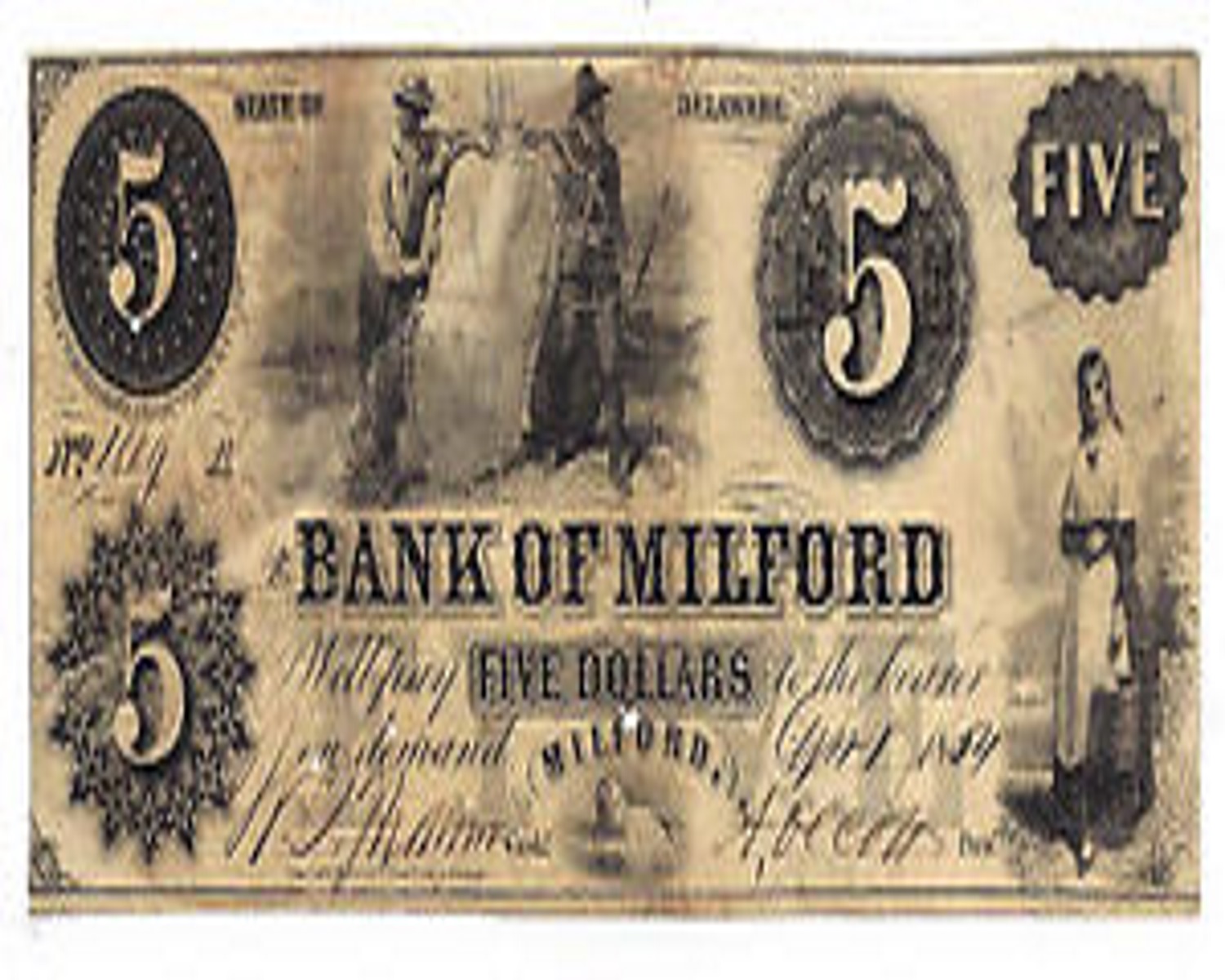
In that era, banks printed their own currency and often travelled to Philadelphia to have their currency designed and printed. The Bank of Milford was no exception, and their notes were printed by Danforth Bald & Company. Danforth was a talented artist and many of the drawings depicted on the Bank of Milford currency are his own designs. It has several vignettes and symbols native to Milford, such as shipbuilding and blacksmith foundries.
Questions arose when people stopped getting change in gold or silver from the bank but received a paper “script” note. This was very uncommon as banks kept gold and silver to back the currency they gave out. As fewer coins were given, the more people grew suspicious. Milford attorney James P. Lofland reached out to the Delaware Attorney General and the Court of Chancery to look into the bank.
During his inaugural address as governor on January 12, 1855, Peter F. Causey mentioned the bank.
“In 1851, the legislative chartered a bank with a capital of $50,000, to be established in the town of Milford, the stock of which was all or nearly all, taken by the citizens of New York, which was used for the purpose of private speculation, and by its failure to redeem its bills in specie, inflicted losses upon the people, which, however, was loss insignificant in importance when compared to the dishonor which was thus for the first time inflicted on the character of Delaware bank paper.”
On January 17, 1855, the House of Representatives referred the issue to a three-man committee to investigate the bank’s practices. A week after the committee convened, they sent for “persons or papers to examine witnesses under oath, and to employe a clerk to record proceedings.” Two days later, the committee was increased to five members who quickly decided to employ counsel in the matter.
The committee submitted a lengthy report on February 21, 1855, to the House of Reprentatives. The report found that Bloodgood, Clark and Colgate committed alleged fraud. The report contended that the president, commissioners and stockholders would be from Milford, but that the three men owned all stock and used the bank to their own purposes except for a few shares that had been transferred to a few New Castle residents to meet the residency requirements.
On March 2, 1855, the General Assembly repealed the incorporation of the Bank of Milford which then allowed someone to take over the bank. Charles T. Fleming was appointed the receiver after Lofland, who held shares in the bank, filed a petition on March 29, 1855.
Litigation resulted in final payments to shareholders of pennies on the dollar. Once everything was settled, the state ordered all currency issued by the Bank of Milford be burned in the courthouse stove with officers of the court witnessing the burning. However, Alonzo Reynolds, who was hired to construct the new bank building, was owed for his services.
Reynolds filed a lawsuit against the president, directors and company of the Bank of Milford to recover the $6,000 note, about $256,777 today, for the construction work he had done, on April 27, 1855. The court sided with Reynolds and a sheriff sale was held on December 8, 1855, at the Union Hotel. The partially constructed building was sold to the Farmer’s Bank of Delaware. On January 20, 1857, the bank sold the property to Dr. James Mitchell who completed the construction.
Not all the notes were burned at the courthouse, however, as the Delaware Public Archives has many of the $1 and $2 notes and, in fact, guards used to give them away as a souvenir because there were so many of them stored there.
The building still stands today and is known as the Bank House. There is no information on what happened to Bloodgood, Allen or Clark.