





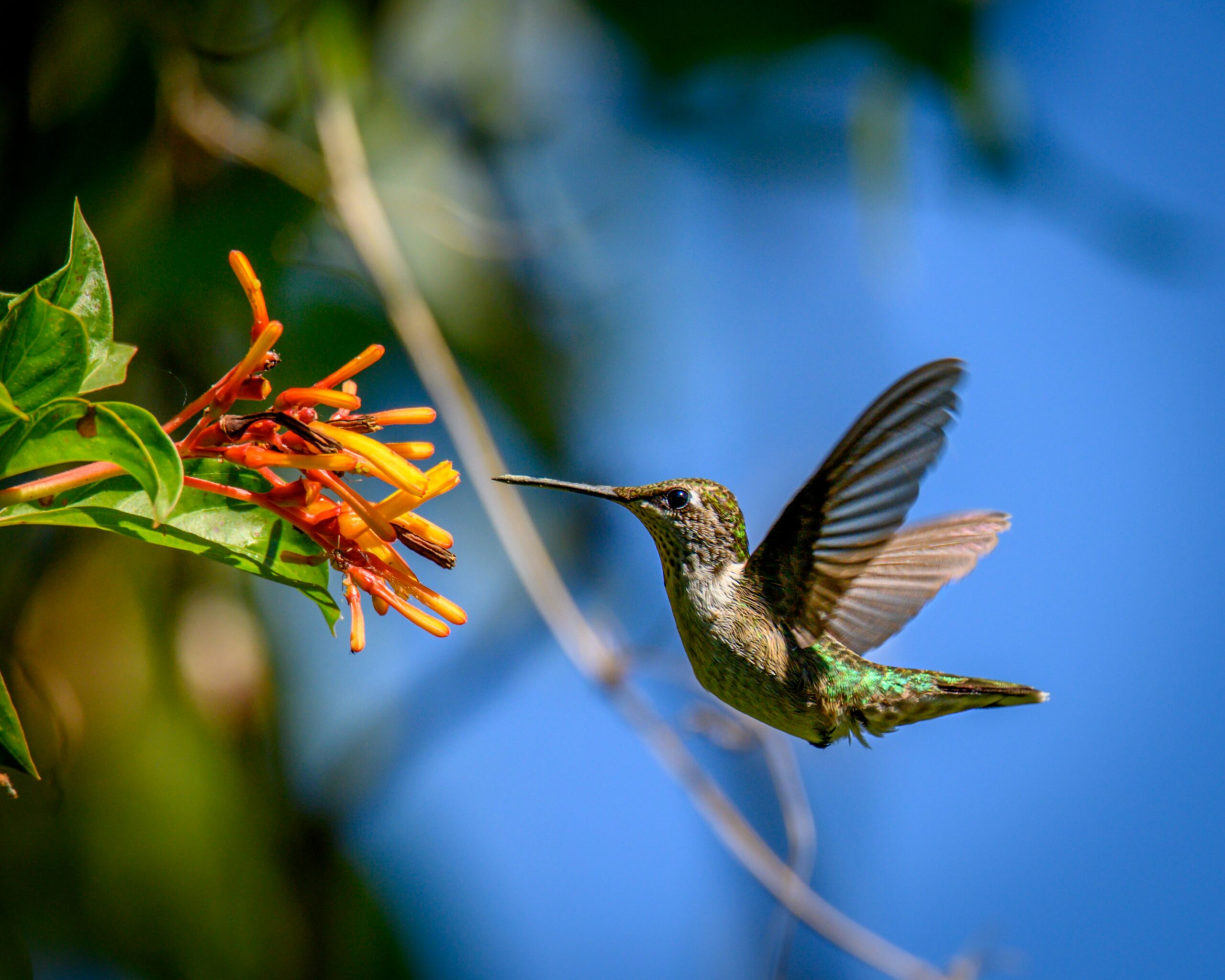

The only hummingbird to breed in Delaware, the ruby-throated hummingbird, scientific name Archilochus colubris, is a marvel of speed and color. Ales have a bright, iridescent red throat patch while females don’t have the red throat but do have the bright green body.
The birds migrate from Central America every spring, crossing the Gulf of Mexico in a nonstop flight. In Delaware, their habitat is gardens, wood edges and meadows. Hummingbirds are the only birds who can fly backward and hover in mid-air. They can also fly upside down.
They hover like helicopters and can beat their wings between 50 and 90 times per second. The birds are tiny, only about three inches tall and weighing only about a tenth of an ounce. They can live for three to five years in the wild. Male hummingbirds perform dramatic, acrobatic dive displays and loop flights to impress females.
Hummingbirds feed on nectar, tiny insects and spiders. Adults mainly feed on nectar, but they feed small insects and spiders to their nestlings. They can remember every flower in their territory and visit up to 1,000 blossoms per day while feeding as they must eat half their body weight daily. They have no sense of smell and find flowers or feeders using sharp eyesight. They are attracted to red or orange which is why feeders of other colors are not as easily recognized.
You can attract hummingbirds by planting trumpet vine, bee balm and salvia as well as by placing feeders with nectar in your yard. Experts say to fill feeders with clear liquids as food coloring used in tinted nectar can be harmful. You can make your own nectar by boiling four parts water mixed with one part refined white sugar. Honey and brown sugar turn rancid faster and can make ruby-throated hummingbirds sick. Clean feeders often with a vinegar-water solution as mold can build up in the feeding tubes.

Ruby-throated hummingbirds fiercely protect feeders, chasing any competitors away, even if they are not feeding at the moment. Their legs are tiny and only used for perching or scooting sideways. They cannot hop or walk. By contrast, a hummingbird’s heart makes up almost three percent of their body weight.
Nests are built on tree branches and are no larger than a walnut. The nests can be found about 10 to 20 feet above the ground. Hummingbirds camouflage their nests using lichens and spider silk. They lay two eggs that are about the size of a pea. The female incubates the eggs for 11 to 16 days and they leave the nest in about 18 to 20 days. Once the female is attracted by the looping acrobatics of the male and the pair lay eggs, the male’s job is done. The male does not help build nests or raise chicks.
The female ruby-throated hummingbird takes the sole responsibility to build nests incubate eggs and feed the young.
In Delaware, ruby-throated hummingbirds are active from around mid-April until September