


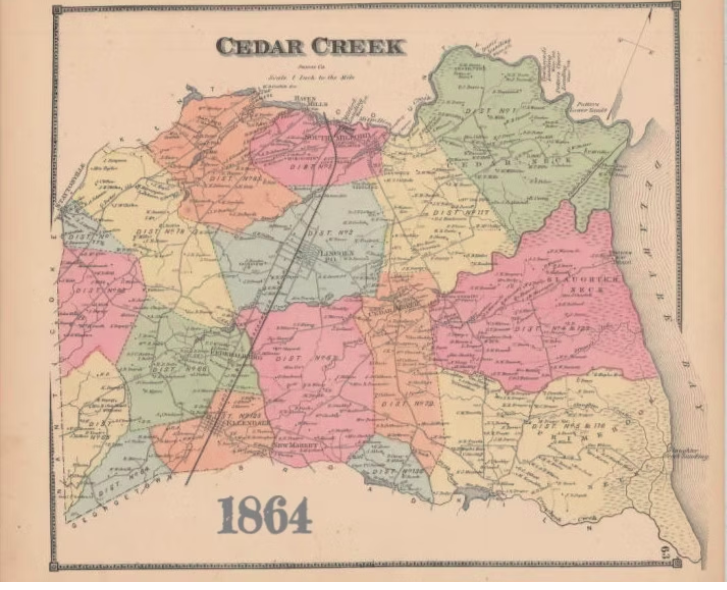

Cedar Creek was named for the abundance of cedar trees that grew along its banks. Originally, the land of what is now called Cedar Creek Hundred was part of St. Jones County, but, in 1683, when St. Jones became Kent and Whorekill became Sussex, the Mispillion River became the dividing line for the two counties, although it was originally supposed to be Cedar Creek.
This is the most northern hundred in Sussex County and is bounded on the north by the Mispillion, the east by the Delaware Bay, the south by Prime Hook Creek and on the west by Nanticoke and Mispillion Hundreds.
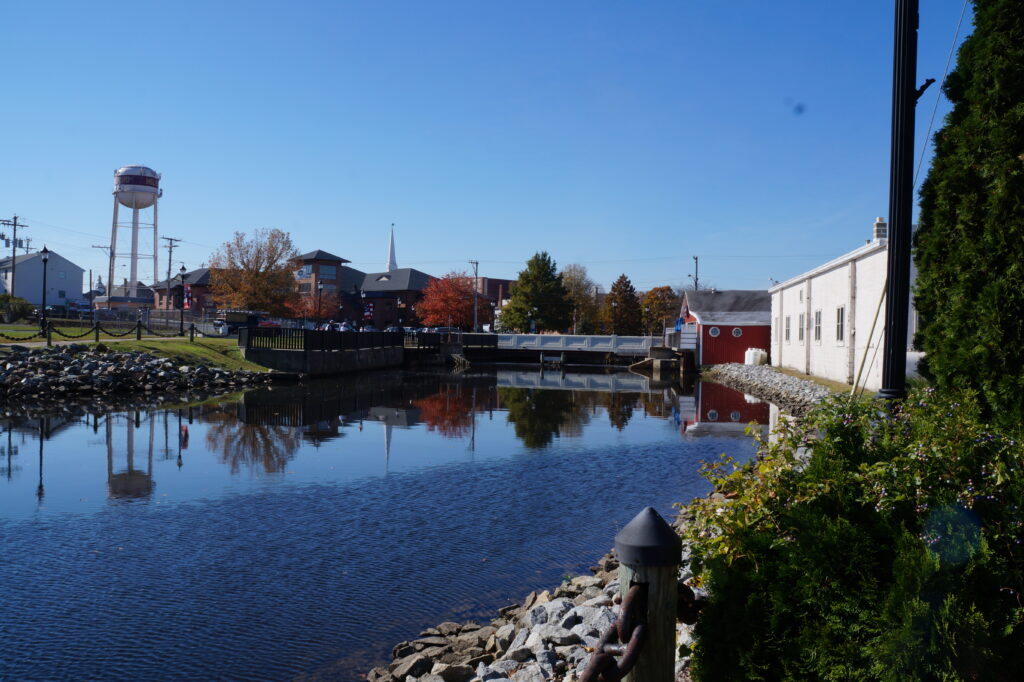
With numerous small streams, the land has had significant water supplies which made it perfect for agriculture. Cedar Creek is navigable for the most part to the brick granary, although modern roads and bridges have made it less so. However, there were times in the past when the mouth of the stream would fill with sand making it difficult for shipping.
In an effort to resolve the sand issue, an act was passed February 2, 1793, to cut a canal beginning at or near Lewis’ Ditch in cedar Creek and to run into the Delaware Bay or Mispillion Creek. This was not completed until 1848 when George R. Fisher was instrumental in digging a canal from this point to the Mispillion Creek. In 1869, the Cedar Creek Navigation Company was incorporated and the channel was dug.
Early settlements near Cedar Creek existed as early as 1671. On June 21 of that year, a patent was issued by Governor Lovelace to Richard Perrott of Virginia. The land passed to the grandson of Richard Perrott, who was also named Richard Perrott. The grandson conveyed his interest to Berkely Codd, one of Perrott’s descendants on October 29, 1718.
Cedar Creek Village, situated near the center of the hundred, had a grist mill, a sawmill and three residences but today is a skeleton of its former self. At one time, it was the most important village in the hundred with a church, store, hotel as well as the mills. For many years, the voters of the hundred assembled to express their views in regard to national and local affairs by casting ballots.
In fact, a news article published on Thursday, February 8, 1894, in the Morning News mentioned there was great interest in the incident of last Saturday in Cedar Creek.
“The Republicans are determined to have every man who is entitled to a tax receipt given one in return for money offered,” the article read. “Some of the most prominent Democrats are opposed to any attempt to prevent the payment of taxes by Republicans. It has been stated that the assessment list of Cedar Creek hundred is padded. An actual count, however, of the assessables on the list of 1891 and that of 1828 shown that there are actually 91 assessables less on the latter than on the former. Of course, this disposes of the charge of a padded list. It has also been asserted that 87 negroes were assessed who should not have their names on the list. This has been disproved by producing in person every negro whose name is on the list and by proving the residence of each one.”
In 1812, Governor Haslett centered troops in Cedar Creek Village for the defense of Lewes. He resided there during his gubernatorial term and, at his death, was buried nearby.
The first post office in Cedar Creek was built in Lincoln in 1865 with James J. Jackson the first postmaster. His wife, Lucy, was his successor.
As early as 1795, there was a hotel at Cedar Creek Village, kept by Daniel Rogers. Later, it was owned by James Ward, Jesse walls, Isaac Carpenter and William B. Coulter. The hotel ceased operation in 1861.